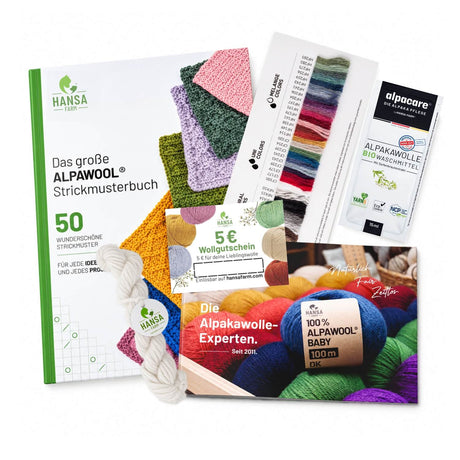
In an age when screens dominate much of many children's daily lives, many parents are looking for meaningful activities that promote creativity, concentration, and practical skills. This is exactly where knitting can play a surprisingly valuable role.
Knitting is much more than just a traditional craft. Children learn patience, develop their fine motor skills, and experience the joy of creating something of their own with their own hands. At the same time, it provides a valuable break from the digital everyday life.
In this article, you will learn why knitting can be a meaningful activity for children, which skills it helps develop, and how to make getting started particularly easy.
What do children learn from knitting?
Knitting combines creativity with practical skills. Even simple projects help children develop important competencies.
Development of fine motor skills
By holding the needles, guiding the yarn, and forming the stitches, children train their hand-eye coordination. These movements promote fine motor skills and can also be helpful in other activities such as writing, crafting, or playing music.
Concentration and attention
Each stitch builds on the previous one. This helps children learn to concentrate on a task for longer periods and to work step by step.
Patience and perseverance
Not every project is finished right away. Children learn that good results take time. This experience strengthens their ability to persevere even when facing challenges.
Creativity and self-confidence
Choosing colors, designing patterns, and finally holding a finished piece in your hands: This promotes creativity and strengthens confidence in your own abilities.
Why knitting is particularly valuable today
Knitting has been experiencing a renaissance for several years. More and more people are discovering the benefits of handicrafts as a mindful balance to their hectic everyday lives.
For children, knitting offers the opportunity to find a counterpoint to digital media. Instead of just consuming content, they create something new themselves.
This creates a special sense of achievement: From a simple ball of yarn, a visible result is created step by step.
Another advantage: Knitting can connect generations. Grandparents, parents, and children can spend time together and pass on knowledge.
Which skills does knitting support in the long term?
The skills learned through knitting often extend far beyond handicrafts.
Learning problem-solving
A dropped stitch or a small mistake in the pattern is part of the process. Children learn to find solutions and not to view mistakes as failures.
Developing a sense of responsibility
Anyone who starts a project takes responsibility for completing it. This strengthens independence and self-organization.
Appreciation for materials
Children better understand how much work goes into clothing and textiles. This often leads to a more conscious use of resources and products.
How to make getting started with knitting easy for children
To help children develop a love of knitting, getting started should be made as easy as possible.
Proven tips for beginners
- Start with thicker yarn
- Use large, easy-to-grip knitting needles
- Choose small projects
- Guide them patiently and allow mistakes
- Choose colors that the child likes
Suitable first projects include:
- Scarf
- Headband
- Simple cushion
- Doll scarf
- Small bracelet
Most importantly, the fun of trying things out.
Which wool is particularly suitable for children?
For children's projects, soft, easy-to-work-with yarns are particularly important.
Alpaca wool is valued by many knitting enthusiasts for its soft feel, light weight, and comfortable wear. For simple children's projects, yarns that glide easily over the needles and create an even stitch pattern are particularly suitable.
The alpaca yarns from Hansa-farm are processed directly in Peru and offer a wide selection of colors and yarn thicknesses for creative knitting ideas.
Common mistakes when knitting with children
Choosing projects that are too complicated
Children quickly lose motivation if the project is too difficult.
Having expectations that are too high
The learning process is the priority, not the perfect result.
Correcting mistakes immediately
Small irregularities are part of the process and promote the learning process.
Planning knitting sessions that are too long
Short, positive experiences of success motivate much more effectively than long practice sessions.
Why knitting remains a meaningful leisure activity
Many hobbies come and go. Knitting often stays with people for a lifetime.
Children not only learn a practical skill, but also develop skills that can support them in school, their careers, and everyday life. Patience, concentration, creativity, and self-confidence are among the most important qualities promoted by regular knitting.
At the same time, something is created that has become particularly valuable in our fast-paced times: the joy of creating something with your own hands.
Knitting is much more than just a hobby for children. It promotes concentration, fine motor skills, patience, and creativity in a playful way. At the same time, children learn to carry out their own projects and discover the joy of crafting.
Anyone who wants to provide children with a creative balance to their digital everyday life will find knitting a valuable and long-lasting activity.
Discover the high-quality alpaca yarns from Hansa-farm and find the right yarn for joint knitting projects with children.